
Navigation
Plants

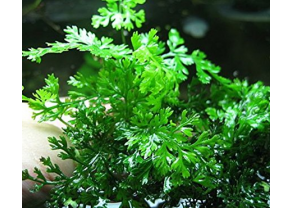
African Fern
Small, delicate fern preferably attaching itself to a stump using nylon thread, until rooting itself onto said decoration. Do not cover the rhizome which could rot if covered. Co2 supply is recommended for its growth and the maintenance of an acidic pH for its water is the recommended way for the best results.
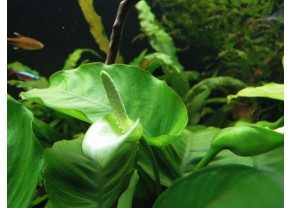
Anubias barteri
Une grande Anubias qui peut atteindre pratiquement la trentaine de centimètres, elle en possède autrement toutes les mêmes caractéristiques que les autres membres de sa famille. Ses feuilles particulièrement robustes ne peuvent pas être mangées par les poissons, même par les célèbres poissons rouge pourtant bien voraces.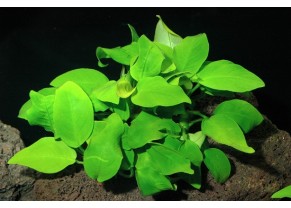
Anubias barteri var. nana "golden"
L'Anubias nana "golden" est une petite plante séduisante qui pousse dans tous milieux, issue d'une sélection naine d'Anubias barteri var Nana. La croissance est lente, les feuilles pouvant durer plusieurs années, ce qui laisse parfois le temps aux algues le temps de s' établir.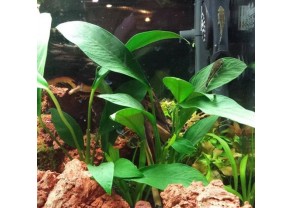
Anubias congensis
Anubias congensis or Anubias afzelii is an excellent beginner plant. As with all members of this family, the horizontal rhizome should be exposed and never planted into the substrate layer. Grows best when attached to driftwood. Easy, low maintenance plant. Good for beginners, rarely eaten by fish.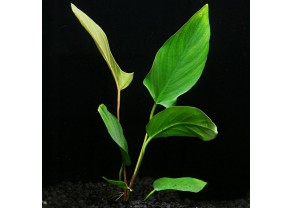
Anubias hastifolia
As with all members of this family, the horizontal rhizome should be exposed and never planted into the substrate layer. Grows best when attached to driftwood. Easy, low maintenance plant. Good for beginners, rarely eaten by fish.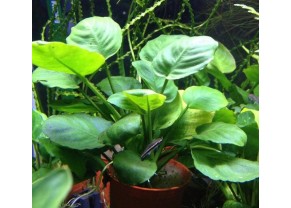
Anubias nana "roundleaf"
Dwarf Anubias is an excellent foreground plant. As with all members of this family, the horizontal rhizome should be exposed and never planted into the substrate layer. Grows best when attached to driftwood. Easy, low maintenance plant. Good for beginners, rarely eaten by fish.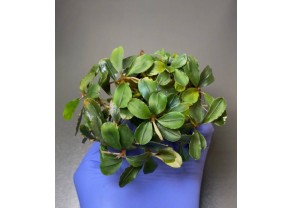
Bucephalandra Malawi Pink
A rhizome aquatic plant prized for its compact foliage with pink and metallic highlights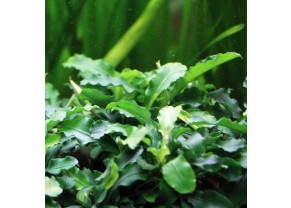
Bucephalandra Mix
Bucephalandra 'Wavy Green' is an easy, slow-growing plant that prefers lower light levels. A nice, dense appearance is ensured by the willingness to branch, even without trimming. The green leaves are 2 cm wide and 5 cm long with wavy edges. Tiny white spots will appear on immerse leaves. The creeping stem, rhizome, must not be covered when planting. This will cause the plant to rot and die.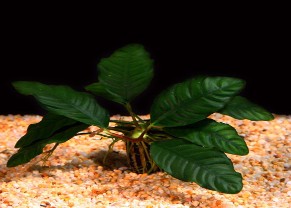
Coffee Anubias
As with all members of this family, the horizontal rhizome should be exposed and never planted into the substrate layer. Grows best when attached to driftwood. Easy, low maintenance plant. Good for beginners, rarely eaten by fish.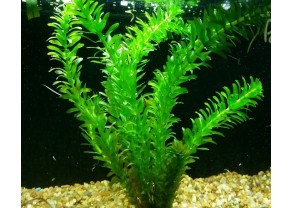
Common Elodea
Fast growing stem plant that prefers cooler, mineral-rich water and strong lighting. Will require liquid supplementation for optimal growth. Has been none to react poorly to copper. Be sure to plant the stems a few centimeters apart so that light can reach the bottom leaves.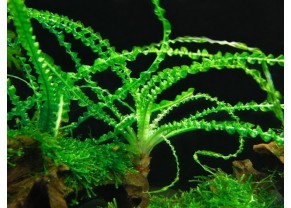
Crinum Calamistratum
Plante délicate aux feuilles finement dentelées. Rarement mangée par les poissons herbivores. Peut tolérer une eau légerement dure et salée. Il faut que 2/3 du bulbe soit visible lorsque planté.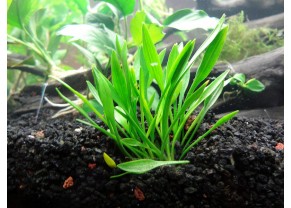
Cryptocoryne parva
Cryptocoryne parva from Sri Lanka is the smallest of all Cryptocorynes (only 3-6 cm tall and a roset less than 5-8 cm wide). It is one of the few species that does not significantly change its leaf shape and colour depending on cultivation conditions. It needs more light than most other Cryptocorynes because it almost loses its leaf blade under water. So it must never be overshadowed by other plants. Individual plants should be planted a few centimetres apart, and after about six months they will form a cohesive low group of plants. Recommended for foreground planting.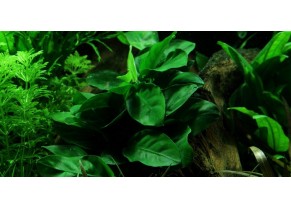
Dwarf Anubias
Dwarf Anubias is an excellent foreground plant. As with all members of this family, the horizontal rhizome should be exposed and never planted into the substrate layer. Grows best when attached to driftwood. Easy, low maintenance plant. Good for beginners, rarely eaten by fish.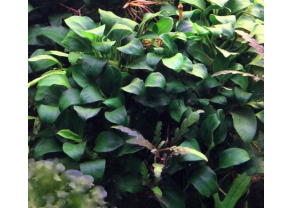
Dwarf Anubias 'mini'
Dwarf Anubias is an excellent foreground plant. As with all members of this family, the horizontal rhizome should be exposed and never planted into the substrate layer. Grows best when attached to driftwood. Easy, low maintenance plant. Good for beginners, rarely eaten by fish.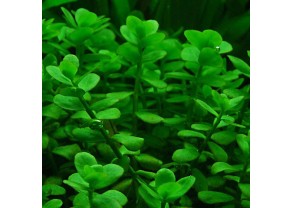
Dwarf Bacopa
Bel effet décoratif lorsque planté en groupe de 15-20 rameaux de taille échelonnée. Lorsque l'éclairage est suffisant, les rameaux sont plus compacts et poussent moins rapidement en hauteur pour puiser leur lumière.
- Search by keywords:
- Remove This Item Growth rate: Fast
- Remove This Item Growth rate: Slow
- Remove This Item Luminosity: Medium
- Remove This Item Luminosity: High
- Remove This Item Luminosity: Low
- Origin
- Africa (9)
- America (1)
- Asia (7)
- Central America (3)
- Cultivar (2)
- North America (1)
- Oceania (1)
- South America (3)
- Plant type
-
 Fern & moss
(4)
Fern & moss
(4)
-
 Stem plants
(7)
Stem plants
(7)
-
 Rosy plants
(11)
Rosy plants
(11)
-
- Temperature
- Water acidity (pH)
- Growth rate
- Slow (18)
- Medium (13)
- Fast (4)
- Luminosity
- Low (11)
- Medium (9)
- High (2)
